
Across South Florida, cranes crowd the skyline and infrastructure needs are reshaping communities from Aventura to Homestead. But construction’s future depends on more than concrete, steel and blueprints. It depends on people with the skills to build.
Miami Dade College is helping prepare the workforce through its Construction Trades Institute, a growing training hub that connects students with hands-on skills, industry credentials and clear pathways into essential careers. Launched in 2023 in response to a shortage of skilled tradespeople, CTI offers programs in electrical systems, HVAC/R, plumbing, telecommunications and fiber optics and construction project management.
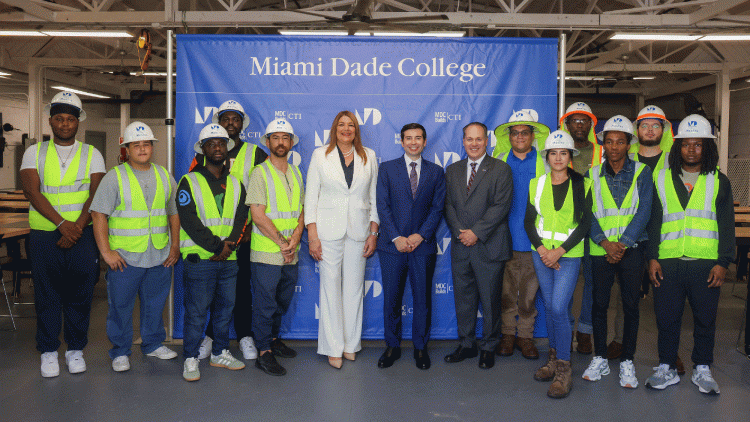
The institute’s approach recently drew national attention when Acting U.S. Secretary of Labor Keith Sonderling toured MDC’s North Campus and the College’s Broadband Utilities Lab. Developed with Miami-based infrastructure company MasTec, the lab gives students experience with telecommunications, fiber optics and utility infrastructure using the tools, techniques and safety practices they will encounter in the field.
“I really commend MDC for going out into the community and talking with industry leaders and finding out what they need,” said Sonderling. “The College is continuing to lead the way in industry-designed programs.”
For students, the benefits can be immediate. In many programs, training can be completed in three to four months, allowing them to move quickly into the workforce. As an NCCER training provider, CTI gives students access to nationally recognized credentials valued by employers. Students can also earn
OSHA credentials and, in some programs, college credits toward an Associate in Science in Building
Construction Technology.
For Liseth Archury Quintero, a graduate of the telecommunicationsand fiber optics program, that training quickly led to opportunity. With support from Hispanic Unity, she completed two months of instruction and earned OSHA-30, CPR and First Aid, Certified Fiber Optic Technician and Certified Fiber Optic Specialist credentials. Soon after, she was hired by MasTec as a fiber splicer technician in a growing field where women make up only 8 percent of fiber optic splicers, according to the Fiber Optic Association.
Stories like Quintero’s illustrate CTI’s broader promise: helping students gain practical skills, build confidence and enter careers that offer stability and advancement. Program leaders report a completion rate above 93 percent and job placement of roughly 85 to 88 percent within two months, with many students leaving with little to no debt.
That student-centered model is especially important in a region where construction remains central to the economy and employers compete for electricians, plumbers, HVAC technicians, fiber optics specialists and other job-ready workers. Nationally, two million skilled trades jobs could go unfilled in the coming years, and South Florida feels that pressure.
CTI helps close that gap by keeping training aligned with employer needs. Partnerships with apprenticeship programs and companies such as MasTec, which helped co-develop the fiber optics program and hires graduates, give employers a pipeline of prepared candidates while giving students a clearer path from training to a paycheck.
The institute is also expanding access. Already at MDC’s North Campus, CTI is growing into Homestead Campus with support from a second $760,000 Gable Grant from the Lowe’s Foundation. The funding supports scholarships, tools, career services and expanded lab capacity, making it easier for residents in one of the county’s fastest-growing areas to train closer to home.
MDC aims to serve 100 students in Homestead and 300 at North Campus, extending CTI’s reach as demand for skilled workers continues to grow. The grant reflects South Florida’s workforce needs and the College’s role as a regional engine for opportunity and economic mobility.
For MDC, the long-term vision is larger than job training. Leaders see CTI growing into a School of Construction for South Florida, where students can enter the trades, advance through apprenticeships and credentials, and become supervisors, managers, contractors and business owners.
For the next generation of builders, technicians and infrastructure professionals, CTI is more than a training ground. It is a launchpad, helping students build better futures while strengthening the communities, businesses and infrastructure that keep South Florida moving.