
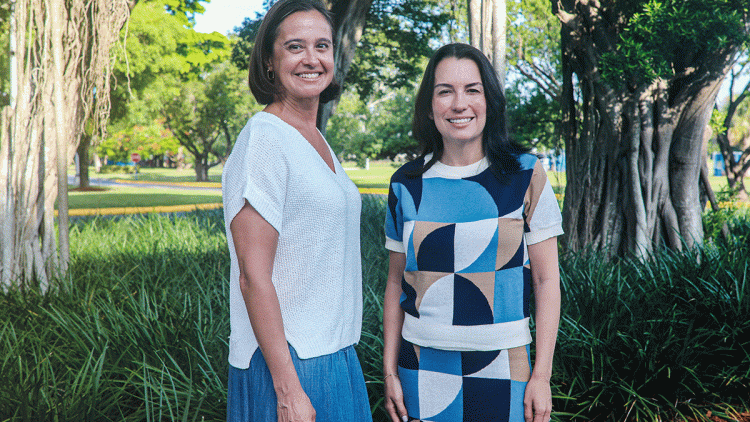
When Dr. Jessica Espinosa thinks about artificial intelligence in early childhood education, she starts not with the technology, but with the teachers who will use it.
Espinosa, a professor of early childhood education at Miami Dade College and an MDC alumna, is studying how early childhood teacher apprentices use AI in the classroom. The apprentices are aspiring educators who work in early childhood settings while completing their training, bringing languages, family histories and cultural traditions that shape how they teach.
Her research grew out of MDC’s AI-enhanced early childhood apprenticeship efforts, supported through the President’s Innovation Fund, which introduced apprentices to tools such as Magic School and NotebookLM. The training showed measurable gains in confidence and AI use. But Espinosa and her research partner, Dr. Christina Muelle, wanted to understand not just whether apprentices used the tools, but what shaped the way they used them.
“We never asked them about what they needed, their culture, their story, how they felt about it, what they bring to the table,” Espinosa said. “We just gave them the information.”
That realization led to a qualitative study rooted in narrative inquiry, a research method built around stories rather than surveys. Espinosa and Muelle are interviewing teacher apprentices about how their backgrounds, classroom experiences and cultural knowledge inform their approach to AI. The researchers then write first-person narratives in the apprentices’ voices and invite them to review, correct and validate the stories.
“The purpose is to create stories that capture what a simple checklist or a survey can’t,” Espinosa said.
The study is grounded in the idea of “funds of knowledge”: the skills, wisdom and know-how people build through experience. For Miami-Dade County’s future teachers, that might include multilingualism, caregiving traditions, immigration journeys or community networks. Espinosa sees those experiences as assets that can deepen classroom learning.
One apprentice, for example, remembered learning measurement through cooking with her grandmother. With AI, she explored how to turn that memory into a lesson that also connected with the foods and traditions of her own students, many from Haitian families. The tool did not replace the teacher’s judgment. It helped connect personal memory, cultural knowledge and classroom practice.
“She was able to put that into the AI platform and get ideas for lessons that honored her students and their culture,” Espinosa said.
Although the research is still in progress, the early interviews have already complicated some assumptions. Espinosa said some older apprentices and career changers appear more eager to embrace AI than younger teachers, some of whom have raised concerns about environmental impact and other issues.
At MDC, that inquiry carries particular weight. The College’s teacher apprentices reflect the multicultural and multilingual fabric of Miami-Dade County, and many are preparing to teach in some of the nation’s most diverse classrooms. Their stories, Espinosa said, can help broaden a field of research that often focuses on whether educators use AI, rather than why they use it or how identity shapes that use.
For Espinosa, the work is also personal. A first-generation college student, she transferred to MDC during a difficult time for her family and found a place that felt both large and deeply personal. After earning her associate degree, she went on to Florida International University, the University of Florida and Barry University, later spending eight years in a Miami-Dade County Public Schools classroom before returning to MDC, where she is now entering her 13th year.
“MDC just always felt for me like it gave me a chance when I really needed it,” she said. “It just felt like home, and it still feels like home.”